One clear picture of the world, before your day starts.
Morning Mosaic reads several hundred stories from 34 news sources every morning and assembles them into a single short brief. Plain language instead of hyperbole. Every outlet's lean printed next to its name, so the source and where it generally sits are visible together. Ranked by what actually affects people, and it ends with the genuine progress that most of the news day leaves on the floor.
We send one confirmation email so we know the address is really yours. Nothing else arrives until you confirm, and there is nothing to pay.
You did not stop caring. You stopped being able to stand it.
Plenty of people have stopped opening the news, and the reasons they give are not that the world got boring. They report that opening a news app in the morning has become an unpleasant thing to do to yourself, and because it is genuinely hard to tell what is true, what is being shaped, and what is simply being shouted the loudest for the largest number of seconds.
So the day starts one of two ways. Either you skip it, and carry a low hum of guilt about being a person who no longer knows what is going on. Or you do read it, and you walk into your morning holding 40 fragments you cannot order, half of which will turn out to have been the same story wearing four different headlines. Neither of those is being informed. They are just different ways of losing the same 20 minutes.
The survey figures below say this is now common rather than unusual. They measure how many people avoid the news and how much they trust it; the reading that follows, about an industry paid by the second and a reader left to do the sorting, is ours rather than the report's.
News avoidance, worldwide
Of people who say they actively avoid the news at least sometimes, up from 29% a decade ago. In the United States the figure is 45%.
Reuters Institute Digital News Report 2026Trust in news, across markets
Close to the lowest level the same survey has recorded since it began tracking it.
Reuters Institute Digital News Report 2026Would trust a chatbot for news
One reader in five. That is why this product leads with its sources and its method rather than with the machinery.
Reuters Institute Digital News Report 2026Morning Mosaic is built on a plain wager: most people do not want less news, and they do not want a machine's opinion of the news. They want the same information, assembled once, in an order that reflects what it will actually do to people, in language that does not spend their attention before breakfast. And they want to be able to check it, which is why every line in the brief carries a link back to the reporting it came from.
Three parts, in the same order, every morning.
The order does not change, which is the point. After a week you stop reading the brief and start scanning it, because you already know where everything is. It takes about four minutes to read properly and about 90 seconds to skim.
The Briefing
The stories that matter most today, in order. Each one gets what happened in plain sentences, a short line on why it matters to anyone who is not already following it, and, when coverage genuinely splits, a note on how different parts of the press are framing it. Then the sources, each labeled.
The Quick Mosaic
Everything else worth a sentence. One line, one link, no ceremony. This is the part that catches the story you would otherwise have found out about a week late from somebody at dinner.
Bright Tiles
Real progress, reported as news instead of as a consolation prize at the bottom. A treatment that worked, a number that moved the right way, a conflict that de-escalated. It is in the brief because it is true, not to make you feel better.
Read the whole thing.
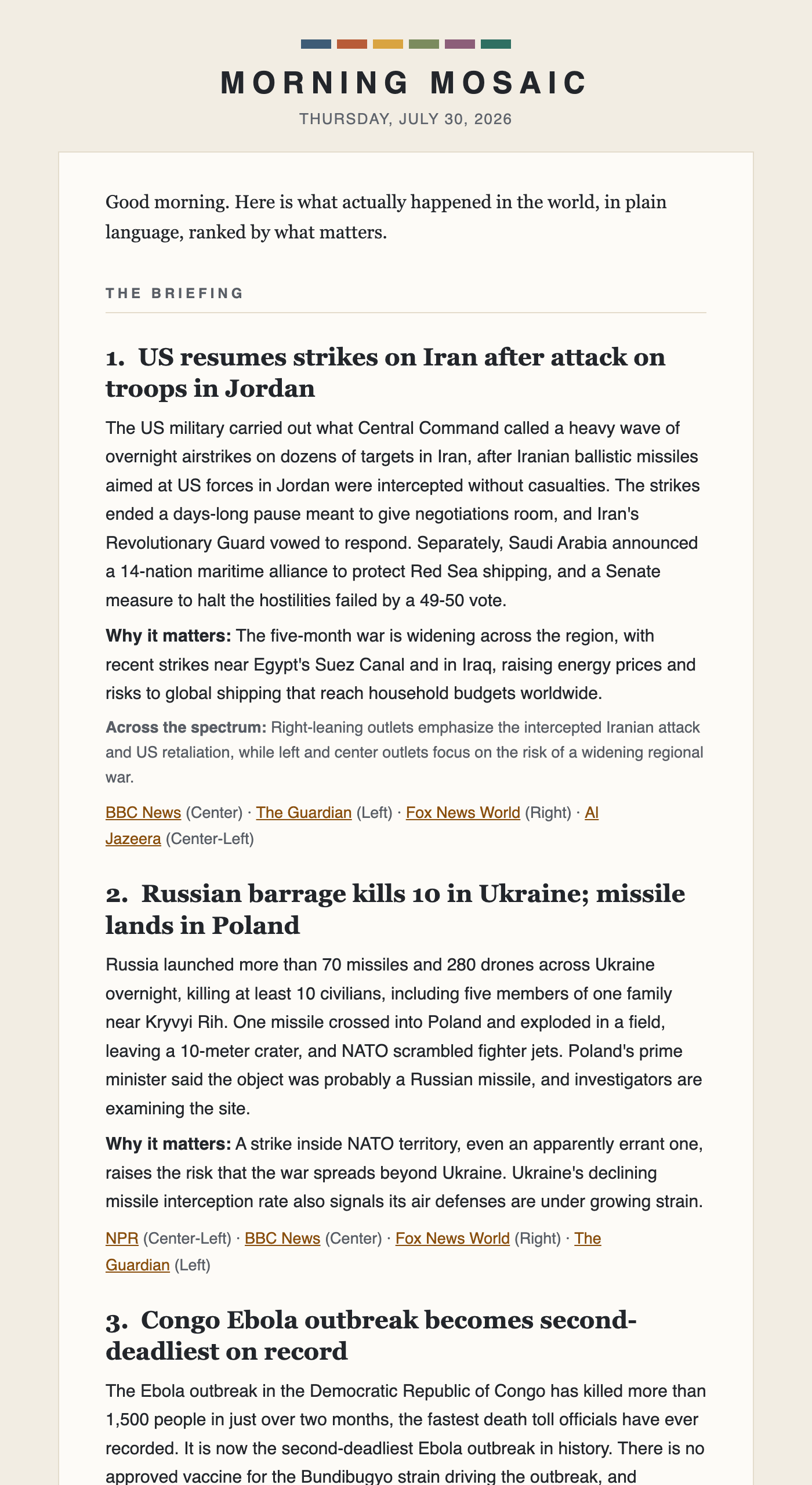
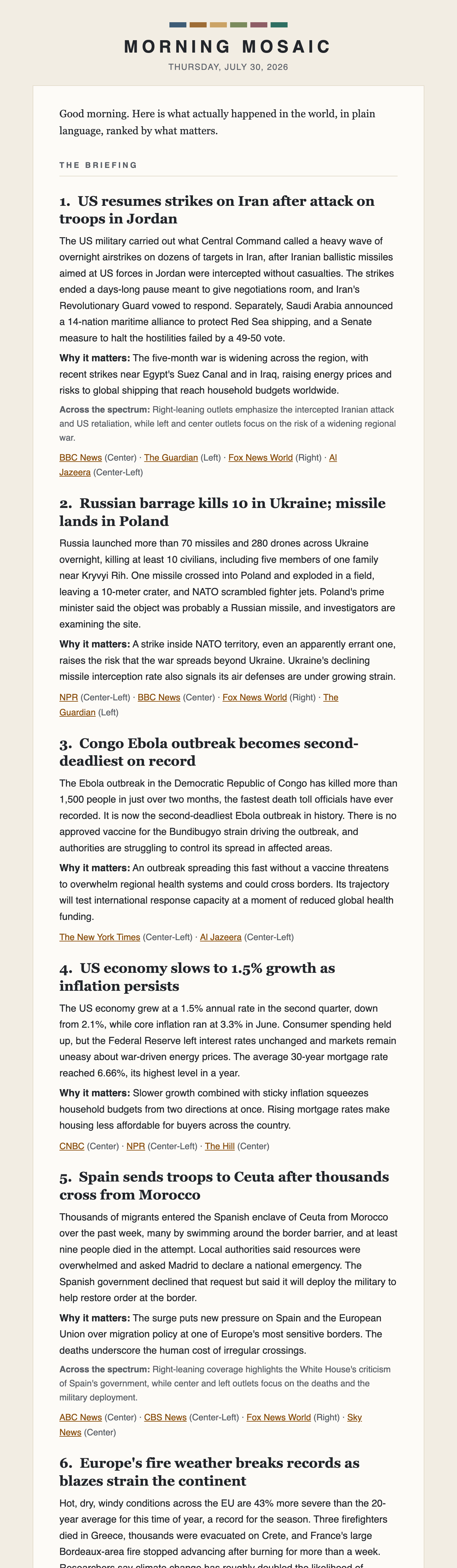
This is the complete brief from 30 July 2026, top to bottom, at the size it arrives. Look at the source lines under each story: BBC News (Center) · The Guardian (Left) · Fox News World (Right) · Al Jazeera (Center-Left). That label describes the outlet's general lean, never the individual story, and it is applied from our own published source table. None of it is invented per article.
You will also notice what is missing. No image blocks that fail to load, no tracking pixels dressed as pictures, no sponsored slot in the third position. The brief is typographic on purpose, so it stays readable with images switched off, in dark mode, and in the mail clients we test.
Every headline links out. We summarize and we point at the original; we never reproduce an article's text. If a story matters to you, the point of the brief is to get you to the reporting, not to replace it.
Six steps, finished before the 6:45am send.
There is no mystery here and no black box worth protecting. This is the whole pipeline, in the order it runs.
-
Read everything
Every source on the published list is fetched directly from its own feed, in parallel, starting a few minutes before the brief is due, and a licensed news index is queried for more from those same outlets. This morning that produced several hundred fresh items. If fewer than 50 come back, the run stops and no brief is sent, because a thin brief is worse than a missing one.
-
Rank by consequence, not by volume
The ordering question is how many people this changes something for, and how much. That is deliberately not the same as how many outlets are covering it, which is the metric that produces a front page of one story in nine costumes.
-
Rewrite in plain language
Each selected story is written out in ordinary sentences: what happened, and one line on why it matters. Hyperbole, unattributed drama, and the words that exist to make you feel something before you have understood anything are removed rather than softened.
-
Label the sources
Leans come from our own source table, which is published below and applied to the outlet, never to the story. A label tells you where a publication generally sits. It does not tell you that a particular piece is wrong, and it is not a score.
-
Check it against the pool
Before anything is sent, a validator re-derives every lean from the source table and drops any citation whose link was not in the fetched pool. On the very first run it caught an invented URL and removed it. This step is not optional and it is not tuned down.
-
Send at 6:45am Eastern
Rendered as a typographic email, contrast-measured against the accessibility standard by a test that ships with a deliberate failing case so the test itself can be trusted, and delivered from our own domain.
The part most briefings will not show you.
Only one in five people say they would trust a chatbot to tell them what happened today, and that is a reasonable position to hold. The answer is not to argue about it. It is to publish the method, so you can check the thing instead of trusting it.
Where the news comes from
Thirty-four feeds today, read directly from the publications themselves, spanning left to right and including international desks. Among them: the BBC, The Guardian, NPR, The New York Times, The Wall Street Journal, Fox News, Al Jazeera, CBS News, ABC News, NBC News, CNN, CNBC, Politico, Axios, The Economist, The Telegraph, The Washington Times, Washington Examiner, The Dispatch, National Review, Vox, Sky News, France 24, Deutsche Welle, Nikkei Asia, and UN News. The whole table is printed below, with the lean assigned to each one. The list grows, and it is versioned, so a change to it is a visible change rather than a quiet one.
What a lean label means
Five positions: Left, Center-Left, Center, Center-Right, Right. It is an editorial judgment about the publication, held in one file, applied consistently, and never generated per story by a model. If you disagree with a label, you are disagreeing with a specific published line rather than with a hidden process, which is the entire reason it works this way.
Where the extra depth comes from
A publication's feed shows only its most recent items, so from 30 July we also query Perigon, a licensed news index, for more articles from those same outlets. Two rules are enforced in code: an article whose publication is not in the table above is discarded rather than published unlabeled, and the lean always comes from our table, never from theirs. It adds roughly half again as many items to choose from on a normal morning.
What we never do
We do not reproduce article text. We do not paraphrase closely enough to be a substitute for reading the source. We do not build on aggregator feeds that repackage other people's reporting without permission: the licensed index described beside this card returns links and short descriptions from publications we already read directly, and nothing from any outlet outside our own table is used. Summaries are short and genuinely transformed, and the link out is prominent by design, not buried in a footer.
What happens when it is wrong
Any automated writing step can produce a claim nobody made. Rather than promising that ours will not, we assume it will and check: every cited link must already exist in the material fetched that morning, or it is removed before sending. That is a mechanical guarantee about citations. It is not a guarantee that a summary is never clumsy, and we will not pretend otherwise.
All 34 feeds, with the lean we assign each one.
This is the file the brief is built from, printed in full. It is here because the rest of this page keeps claiming the labels are checkable, and a claim like that is worth nothing without the table beside it. Disagree with a row and you are disagreeing with a specific published line, which is the entire point.
The spread today: 3 Left, 9 Center-Left, 12 Center, 3 Center-Right, 7 Right. That is not a balanced set and we are not going to describe it as one. It leans to the center and center-left, mostly because that is where the large general-news desks with open feeds sit. It is less lopsided than it was: six feeds were added on 30 July, four of them on the right, and two of those are foreign desks rather than American ones. Widening it further is ongoing work, not a finished job.
| Publication | Assigned lean | Desk |
|---|---|---|
| BBC News | Center | International |
| BBC Top Stories | Center | International |
| NPR | Center-Left | United States |
| The Guardian | Left | International |
| The New York Times | Center-Left | United States |
| NYT Front Page | Center-Left | United States |
| The Washington Post | Center-Left | United States |
| The Wall Street Journal | Center-Right | United States |
| Fox News | Right | United States |
| Fox News World | Right | United States |
| Al Jazeera | Center-Left | International |
| CNBC | Center | United States |
| Politico | Center-Left | United States |
| The Hill | Center | United States |
| Axios | Center | United States |
| CBS News | Center-Left | United States |
| ABC News | Center | United States |
| NBC News | Center-Left | United States |
| Sky News | Center | International |
| France 24 | Center | International |
| The Economist | Center-Right | International |
| National Review | Right | United States |
| New York Post | Right | United States |
| Vox | Left | United States |
| Mother Jones | Left | United States |
| CNN | Center-Left | United States |
| Deutsche Welle | Center | International |
| UN News | Center | International |
| The Telegraph | Right | International |
| The Washington Times | Right | United States |
| Washington Examiner | Right | United States |
| The Dispatch | Center-Right | United States |
| Nikkei Asia | Center | International |
| Christian Science Monitor | Center | International |
three publications appear twice because two of their feeds are read separately: BBC News, The New York Times, and Fox News. That is why the table has 34 rows and 31 distinct publications. A label describes the publication, never the individual story, and it is not a factuality score: a Right-labeled outlet breaking an accurate story is an accurate story, and the label is there so you know whose desk it came from.
A brief that lands every morning, and a road map moving fast.
The daily email has been sending every morning since 30 July 2026, without a miss. Everything below it is what ships next.
| Capability | Status | What it means |
|---|---|---|
| Daily email brief | Built | Sends at 6:45am Eastern from our own domain, on any morning the source pool clears the refusal floor. |
| Outlet lean labels | Built | Five-point scale from a published source table, applied to publications. |
| Impact ranking | Built | Ordered by consequence rather than by how many outlets ran it. |
| Progress reported as news | Built | The Bright Tiles section, in every edition. |
| Citation validation | Built | A cited link that was not in the morning's fetched pool is dropped before sending. |
| Across-the-spectrum note | Built | How coverage differs, on the stories where it genuinely does. |
| Renders with images off | Built | Typographic by design, contrast-measured in a test with a failing control case. |
| Licensed wire copy | Planned | An application to a wire service's developer program. |
| Third-party bias and tone data | Planned | Would supplement our own labels with an independent provider's. |
| Daily text message edition | Planned | Requires carrier registration in the United States. |
| Choose your own topics | Planned | Everyone receives the same brief today. There is no personalization at all. |
| Searchable archive on the web | Planned | Past editions are not published anywhere yet. |
| Evening edition | Planned | A second send on days the story moves. |
| iPhone app | Planned | Email is the product today. |
Four minutes, at four different kitchen tables.
The 6:50am scroll, replaced
You reach for your phone before your feet hit the floor, and 20 minutes later you are angry about something that will not affect you and still do not know what happened in the world. One email, read while the coffee brews, ends that particular loop.
Walking into a room informed
Client breakfasts, school runs, standing meetings where somebody will mention the thing that happened overnight. Knowing the five things that actually moved, and where each one was reported, is worth more than having read 40 headlines.
When you have opted out entirely
If you deleted the apps and turned off the alerts and it genuinely helped, this is the version that does not undo that. It arrives once, it has an end, and it never buzzes.
Reading across the line
If you already read widely and want to see, on a given story, that the right-leaning coverage led with one fact and the left-leaning coverage led with another, the across-the-spectrum note and the labeled links put both in front of you in one place.
The others, priced and sourced.
Every price below was read from the vendor's own page on 30 July 2026 and linked, and where a vendor's pricing page could not be read, this table says so rather than repeating a number from somewhere else. Every product below is described in its own terms, with the figure linked to the page it was read from.
| Product | Price, from their page | Outlet lean labeled | Progress as a section | What they offer |
|---|---|---|---|---|
| Morning Mosaic | Free todayNo paid tier is live. Proposal below. | Yes, on every source link | Yes, in every edition | One assembled brief with the lean printed inline and a citation check that removes links it cannot find in that morning's material. |
| Ground News | $8.33/month, billed annuallyVantage plan, plus a free tier | Yes, and factuality ratings too | No | Far more sources, licensed bias and factuality ratings from independent raters, plus an app and a browser extension. |
| Tangle | $6/month or $59/yearBundle with podcast $10/month or $99/year | Argument by side, not a per-outlet label | No | A named human editor takes one story a day and lays out the best arguments from left and right in depth, with a podcast. |
| 1440 | Free"100% free, unsubscribe anytime" | No | Occasionally, not as a section | Millions of readers and years of consecutive daily editions. |
| News Minimalist | Not readableTheir pricing page is behind a bot check, so we are not quoting a figure | No | No | A live web feed you can browse whenever you want, ranked continuously rather than once a day. |
| Boring Report | Not readableNo price stated on the page we could read | No | No | A mobile app, and a longer history of stripping sensational language from stories. |
Read plainly, that table says Ground News is the more complete product, Tangle is the better piece of writing, and 1440 has the audience. What none of them does is the specific combination this one is built around: a single assembled brief where the lean sits next to every link, the ordering is by consequence, the progress is treated as news rather than as a footnote, and the citations are mechanically checked before anything is sent.
The email is free. The rest is a proposal.
$14 a month
The daily brief is free and stays free. The paid tier is $14 a month for the four capabilities below. There is no card form, no checkout, and nothing on this site can be paid for yet. The price is published now, so it is never sprung on you later and you can decide today whether it would ever be worth it to you.
The daily brief
- The full brief, every morning at 6:45am Eastern
- All three sections, all sources labeled
- Every claim linked to the original reporting
- No advertising in the brief
Pro Planned
- The same brief as a morning text message
- Weight the ranking toward the subjects you actually follow
- A searchable archive of every past edition
- An evening edition on the days the story moves
The price is decided. The tier arrives when those four capabilities actually work.
The reasoning, in plain terms: the daily email is the thing people will forward, so keeping it free protects the only channel that grows this. The $14 sits above Ground News at $8.33 a month billed annually and above Tangle's $10 bundle, which is deliberate. A briefing that saves a real 20 minutes a day is not competing on being the cheapest, and a price set low is very hard to raise later. The paid tier has to earn that number, which is why nothing is charged for it today.
What we hold, which is almost nothing.
To send you an email we need your email address. That is the whole list of personal information involved, and there is no second use for it.
- Your address is never sold, rented, or shared with another company. There is no data partner, no list broker, and no arrangement under which somebody else mails you because you signed up here.
- The brief carries no tracking pixel. It is a typographic email with no images at all, so there is nothing embedded in it that reports back when you open it. We do not know who reads it.
- Leaving takes one click and is immediate. Every edition carries an unsubscribe link, and using it removes the address instead of flagging it.
- This site measures traffic in aggregate. Page views and which sections get read, with text and form inputs masked, so an email address typed into the box above is never captured. Do Not Track is respected: if your browser sends it, the measurement does not run at all.
- The confirmation step is deliberate. Nothing is sent to an address until somebody has confirmed it from that inbox, so a stranger cannot sign you up.
Frequently asked questions
What does it cost?
The daily email is free and stays free. There is no card form on this site and nothing to buy. A paid tier is priced at $14 a month, or $120 a year, and arrives when its capabilities do.
When does it arrive?
6:45am Eastern, on any morning there is enough news in the pool to brief. The pipeline starts a few minutes earlier and the whole run, from fetching feeds to sending, finishes in that window. If fewer than 50 fresh items come back, nothing is sent that day, because a thin brief is worse than a missing one.
How many sources does it read?
Thirty-four feeds, from 31 publications, read straight from their own sites. three publications contribute two feeds each. The most recent run produced several hundred fresh items. If fewer than 50 fresh items come back, no brief is sent at all.
What do the labels next to each outlet mean?
They are that publication's general editorial lean on a five-point scale from Left to Right. They come from our own source table, printed in full on this page. They are applied to the outlet and never to an individual story, and they are not generated per article by a model.
Is this written by a machine?
The summarizing and ordering are automated. The source list, the lean labels and the editorial rules the brief is written to are human decisions, held in files, and published. Only one in five people say they would trust a chatbot for news, which is why the method is on this page and every claim in the brief links back to the reporting it came from.
Does it reproduce articles?
No. Summaries are short and genuinely transformed, the link out to the original is prominent by design, and full text is never reproduced. If a story matters to you, the brief is built to send you to the people who reported it.
What stops it inventing a source?
A validator runs before anything is sent. Every cited link must already exist in the material fetched that morning or it is removed, and every lean is re-derived from the source table rather than taken from the generated text. On the first run it caught and removed an invented link.
How do I unsubscribe?
Every edition carries an unsubscribe link that works in one click and removes the address. You can also reply to any brief and ask.
Will you sell my email address?
No. It is used to send you the brief and for nothing else. It is not sold, rented, or shared with another company, and the brief carries no tracking pixel, so we do not know who opens it.
Why is there a section of good news?
Because leaving it out is itself a distortion. Treatments work, conflicts de-escalate, and numbers move the right way, and a briefing that only reports the other kind gives a false picture of the day. Bright Tiles is in every edition and it is reported to the same standard as everything else.
Is there an app?
Email is the product today. A text-message edition and an iPhone app are both on the road map above.
Who is behind it?
Morning Mosaic is built by Belstone. It has been sending every morning since 30 July 2026.
Wake up with the whole picture.
One email a day, free, four minutes, and every line of it links back to the reporting it came from. Confirm your address tonight and tomorrow's brief is the first one you get.
We will send one confirmation email. Nothing else arrives until you confirm it, and unsubscribing takes one click.